
 Shed Dog
 Blood Tracking Dog
 Gun/Bird Dog
 Dog Obedience
 Dog Training Videos and DVDs
 Apparel, Gear & More
 Dog Health Supplements
 About
About Reviews
 Free Videos
 Journal
 Podcast
The Single Most Overlooked Skill in a Young Gun Dog


The Single Most Overlooked Skill in a Young Gun Dog
The single most overlooked skill in a young gun dog isn't sit, it isn't heel, and it isn't even the retrieve — it's composure. Teaching a young dog to be calm, still, and focused before any command is given is the foundation that every other skill in your training program is built on, and it's the one most people skip right over on their way to the fun stuff.
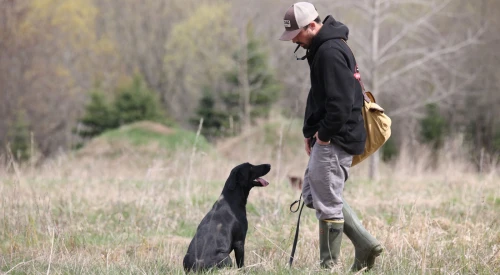
If you've spent any time working with a young gun dog — especially a Lab or a spaniel, where drive comes practically factory-installed — you already know the scene I'm about to describe. You're standing at the line, the bumper is in the air, your dog is coming up off the ground, spinning, whining, completely gone, and somewhere in the back of your mind a small voice says, "this is a problem, isn't it." And it is. But it's not the problem most people think. Far too often, the instinct is to drill more obedience — more sit, more stay — and I understand that impulse completely, because the dog does know its commands. The problem is, knowing a command and having the composure to actually respond to it when everything in the dog wants to go is a completely different thing.
I hear this all the time: "He's perfect in the yard but falls apart in the field." That gap right there — between what the dog knows in a calm, controlled setting and what the dog can actually do under pressure — that gap is composure. And the reason most people don't see it coming is that composure isn't exciting to practice. It doesn't feel like progress. There's nothing to show anybody at the end of a training session where you worked on standing still.
What Does Composure Actually Mean in a Gun Dog?
I want to be clear about what I'm describing, because the word can sound vague when you first hear it. Composure isn't about drive level or natural temperament — some of the best gun dogs I've ever worked with are absolutely INTENSE animals, and that intensity is an asset, not a flaw. What I'm talking about is a trained behavior: the dog's ability to hold itself still, focused, and ready to receive a command, even when everything in its environment is telling it to go right now.
Think of a piano student who can play scales beautifully in an empty practice room but freezes and falls apart the moment they sit down at a recital. The notes weren't the problem. The ability to perform when it actually counts — in the presence of an audience, pressure, and real stakes — is what never got practiced. A young gun dog that knows every command in the backyard but explodes at the line has the same gap. You practiced the scales. You skipped the recital.
Why Do So Many Trainers Skip This Step?
Because it's not exciting, and because a dog with a lot of drive makes it feel like forward momentum is always the answer. If your dog is bursting to go after a bumper, throwing more bumpers feels like you're building on what's already there. And you are — you're just building speed without brakes. A car with no brakes isn't impressive. It's just a matter of when something goes wrong.
What's interesting to me is how often people assume the dog will just settle down as it matures. In all reality, what tends to happen is the dog gets older, bigger, faster, and more confident — and the same break that was manageable at six months becomes a serious problem at two years old. The best time to build composure is at the beginning, before a bad habit has a chance to take root. It's a lot easier to write a new habit than it is to overwrite an old one.
What Does Building Composure Look Like in Practice?
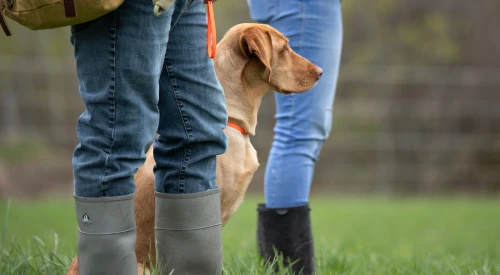
The good news is you don't need fancy equipment or a big field. You need one bumper, your backyard, and about fifteen minutes. The goal is simple: your dog sits at the line, the bumper goes out, and before you release the dog, you wait. You're not waiting for perfect, motionless stillness — you're waiting for the dog to come down off the peak of its excitement, even slightly. Eyes forward, weight settling back, just a breath of quiet. Then you send.
That moment — that brief, still point between the throw and the release — is what you're building. You do this over and over, and over time, the dog learns that the fast path to the retrieve actually goes through the still point, not around it.
Now, I realize that if your dog has already developed a breaking habit, this process looks different and goes a bit deeper — you're essentially rebuilding the approach to the line from the ground up. I walk through that full progression inside the DogBone Training Library, including the specific steps for a dog who's been getting away with breaking for months or even longer.
Does This Apply to Every Type of Gun Dog?
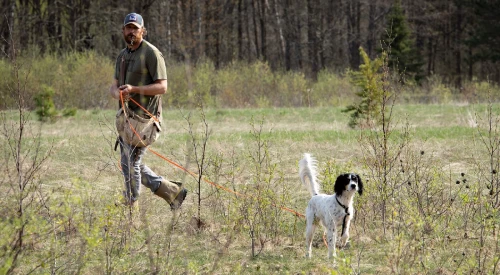
Yes, and it looks slightly different depending on the style of work, but the principle is identical across the board. A pointer holding point is composure. A spaniel that flushes on your flush command instead of breaking on impulse is composure. A Lab that sits steady to the fall, watching the bird come down without breaking, is composure. Across every style of gun dog work, the common thread is an animal that can pause — in the middle of its biggest moment — and wait for direction. You and your dog are capable of building that, I promise you, regardless of breed or background.
Jeremy's 4-Step Approach for Building Composure Early
- Build the sit before you ever add the bumper. If your dog can't sit quietly with no distraction present, adding a thrown bumper isn't going to make it easier. Earn stillness in a low-pressure environment first, then layer in the excitement.
- Add the bumper, then extend the wait. Start at three seconds. Work up to ten. You're making the pause a normal, expected part of the routine — not an emergency stop the dog has to fight against.
- Send from a quiet moment, not from the peak. If you release the dog at the height of the wiggling and whining, you're training the dog that that behavior is what earns the send. Wait for even a brief drop in intensity, then release.
- Keep sessions short and frequent. Three clean marks a day, five days a week beats fifteen marks in one Saturday session every single time. The foundation is built through consistency over weeks, not through volume in a single afternoon. The best way to speed this up is to slow it down — and I mean that.
FAQ
Q: My dog already knows sit and stay — isn't that the same as composure?
A: It's the beginning of it, but it's not the whole thing. Composure is the dog's ability to hold that behavior when the environment is doing everything it can to pull them out of it — birds in the air, wind carrying scent, another dog moving nearby. A sit-stay in the yard with no distractions is step one, and it's a good step. But don't mistake step one for the finish line.
Q: How early can I start working on this?
A: Right now, whatever age your dog is. If you have a twelve-week-old puppy and you can get two seconds of calm before rolling a ball toward them, you're building composure. It doesn't need to be formal or feel like a training session. The habit starts with the very first interaction, and the earlier you make calm a cultural expectation in the house, the easier everything that comes later becomes.
Q: My dog has been breaking at the line for two years. Is it too late to fix it?
A: It's not too late, but I'll be honest with you — it's harder than starting right from the beginning. You're overwriting an existing habit instead of writing a new one, and the dog has two years of muscle memory telling them that's just what happens at the line. It absolutely can be done, and I've seen it happen cleanly, but go in with PATIENCE and don't expect an overnight result.
Q: Do I need to use a correction when the dog breaks?
A: My preference is to set the training up so the break doesn't happen in the first place. If the dog breaks, what it tells me is that I moved too fast and put the dog in a situation they weren't ready for yet. The answer is to back up a step, slow the progression, and let the dog succeed at an easier version before pushing further. Without the use of fear, unnecessary force, and without the use of a shock collar, you can absolutely build a dog with rock-solid composure at the line — it just requires that you slow down to speed up.
Best of luck in your training,
— Jeremy

%COMMENTS%